
Tools × Research Workflow
Fiscal.ai Review (2026): The Research Platform Behind Japan Stock Alpha + 15% Discount Code
Disclosure: This article contains affiliate links. If you sign up through our link, Japan Stock Alpha may earn a commission at no extra cost to you. We only recommend tools we actually use in our own research.
Serious equity research has an awkward economics problem. A Bloomberg Terminal is designed for institutions and is commonly estimated at roughly $30,000 per user per year.
Free sites are useful for prices and headlines, but often fall short when you need long financial histories, segment data, company-specific KPIs, guidance or the original earnings presentation.
That gap is especially visible when researching Japanese stocks in English. A deep dive can mean locating several Japanese IR PDFs, translating labels, rebuilding tables and repeating the process for peers. For Japan Stock Alpha, the bottleneck is usually collecting reliable inputs—not the valuation formula.
The value of a research platform is not that it replaces judgment—it removes the repetitive work that prevents judgment from being applied.
Fiscal.ai offers a free plan. Paid users can enter JSAJAPAN for 15% off on all payments within the first 11 months.
What is Fiscal.ai?
Fiscal.ai, formerly known as FinChat, is a web-based fundamental research platform for public equities, ETFs and funds. Its core product combines standardized and as-reported financials, estimates, valuation ratios, charts and screeners.
It also includes company-specific segments and KPIs, dashboards, ownership information, filings and investor-relations content. The company says its global database covers more than 100,000 securities, while detailed segment and KPI coverage is available for more than 2,250 companies.
Fiscal.ai is built around business fundamentals, not just market prices. It aggregates first-party investor-relations material—including earnings-call audio, transcripts, slide decks, press releases, investor-day material and filings—inside the company workspace, reducing the need to search each corporate website separately.
How Japan Stock Alpha uses Fiscal.ai
Without Fiscal.ai
With Fiscal.ai
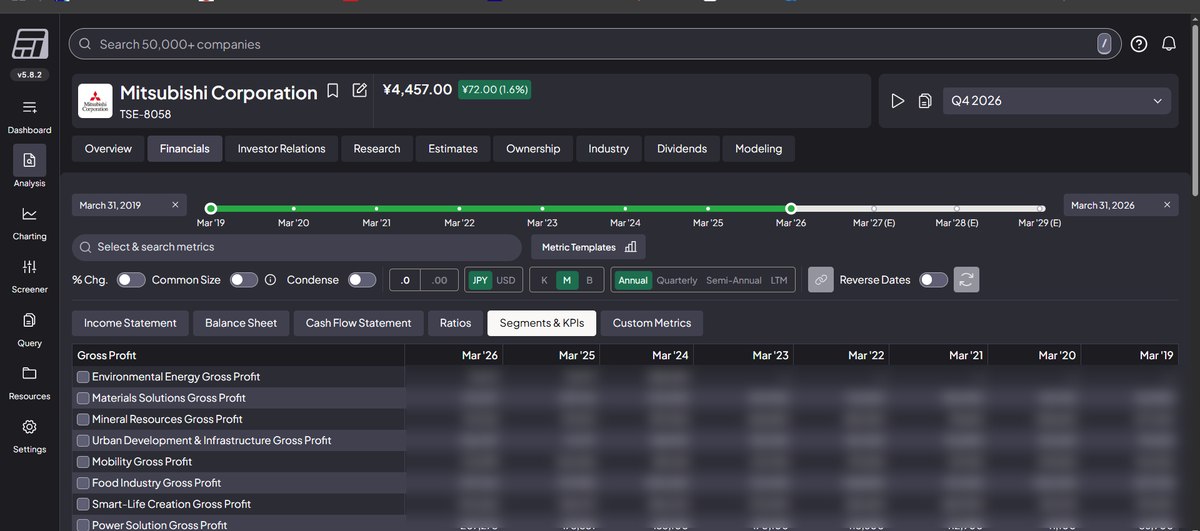
1. Reconstructing Japanese trading-company segments
For Mitsubishi Corporation, Mitsui, Marubeni and Itochu, consolidated earnings are only the starting point. The thesis depends on the mix of resources, machinery, food, power, infrastructure and consumer businesses.
We use Fiscal.ai to pull standardized history and available segment series into one screen, then return to the official presentation for context. The company documents remain the final authority, but the first pass is much faster.
2. Keeping official earnings documents in one place
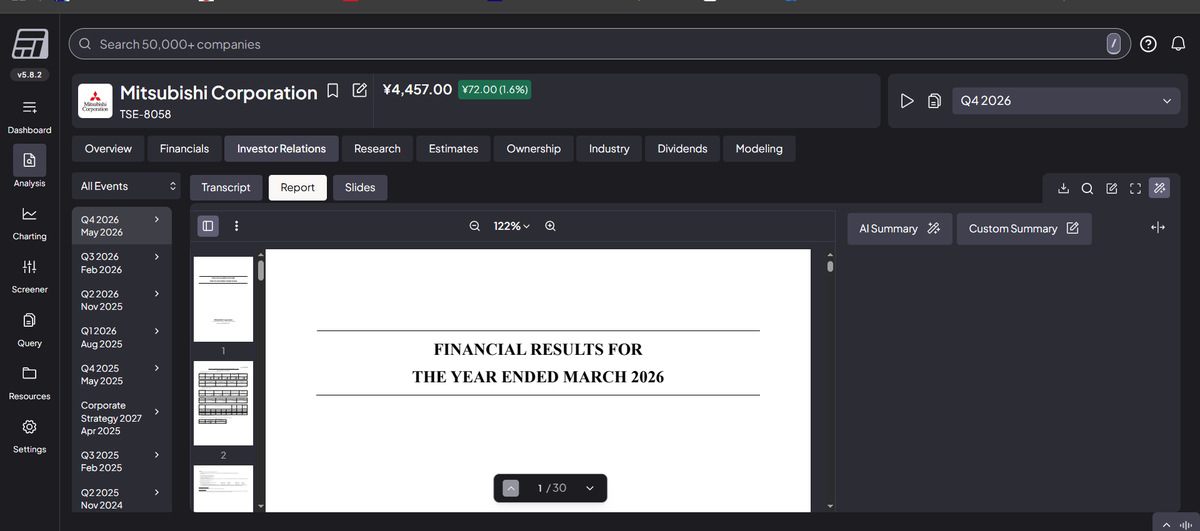
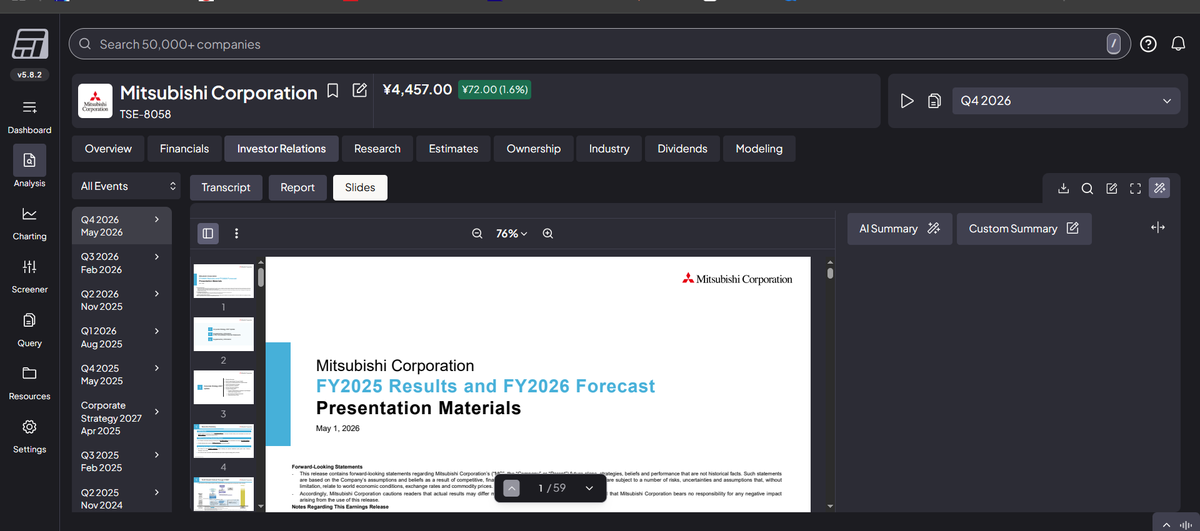
Fiscal.ai aggregates first-party documents from company websites and regulatory sources. An earnings release, results presentation, transcript and filing can often be opened from the same company page.
That matters in Japan, where decisive information may sit in a presentation appendix—order backlog, capacity, shareholder returns or a revised segment definition. Keeping formal materials beside the numbers shortens the audit trail.
3. Comparing semiconductor fundamentals and management language
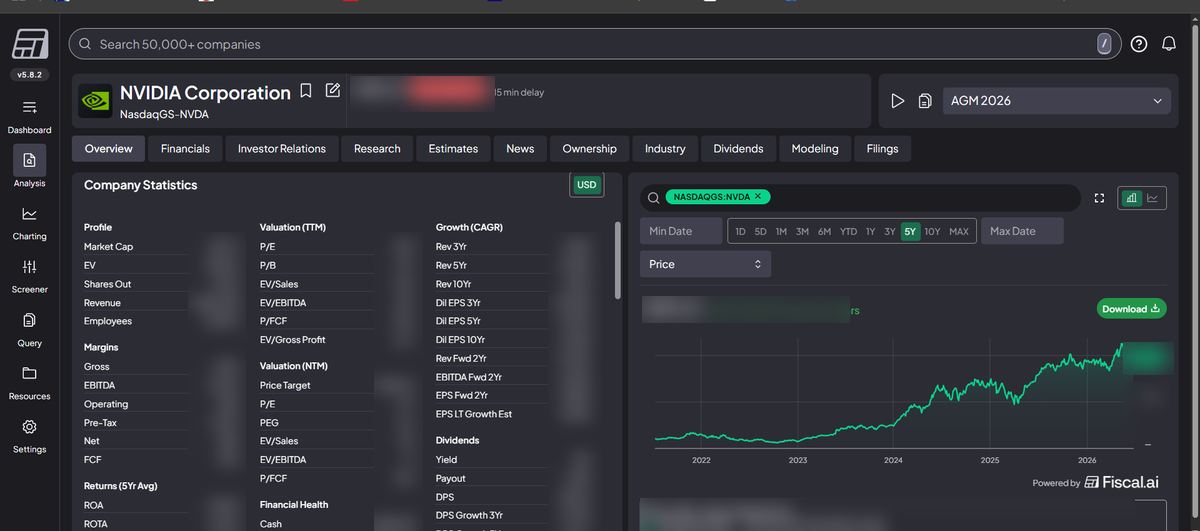
In semiconductors, headline revenue is rarely enough. We care about unit demand, pricing, utilization, inventory, capex, product mix and guidance. Fiscal.ai’s financial, KPI and transcript tools can bring those signals into a comparable workflow when the relevant data is covered.
The example below uses NVIDIA, one of the companies available in Fiscal.ai. Its overview places growth, margins, valuation, balance-sheet indicators and long-term share-price performance on one page, making it a useful first-pass screen before moving into detailed filings and management commentary.
Coverage is not identical for every Asian company. In our Kioxia valuation deep dive, for example, we rely more heavily on Kioxia’s own filings and presentations where platform depth is thinner, while using standardized peer histories to frame the memory cycle and valuation context.
That limitation is worth stating clearly: global coverage does not mean every company has the same KPI, transcript or estimate history.
4. Building the input layer for a DCF model
Fiscal.ai provides long financial histories, margins, cash-flow items, shares outstanding, ratios and estimates in a consistent layout. We use them to identify normalized margins, working-capital patterns, capital intensity and dilution before setting assumptions in our own spreadsheet.
The platform shortens collection; JSA still decides what is recurring and which terminal assumptions are defensible. Readers can compare the finished outputs in our Company Deep Dive collection.
5. Bringing Fiscal.ai data into ChatGPT
Fiscal.ai also offers an API and Model Context Protocol (MCP) connection for compatible AI clients, including ChatGPT. A conversation can call supported tools for company profiles, statements, ratios, prices, segments, KPIs and filings, then create peer tables, calculate margins, organize model inputs or locate the source behind a number.
The caveat: Terminal access and API/MCP access should not be assumed to be the same subscription. The API has separate limits, while connector availability depends on the ChatGPT plan and workspace settings. Material outputs still need checking against the filing or presentation.
Key features—and the research step each one shortens
Segments and company-specific KPIs
Statements tell you what a company earned; KPIs often tell you why. Fiscal.ai tracks business-specific metrics and segment data for more than 2,250 companies, from user metrics to semiconductor end markets and diversified-group segment profit.
Investor-relations documents, transcripts and filings
The workspace brings together formal documents and events. Searchable transcripts track changes in wording, while slide decks and filings provide the tables needed to verify a thesis. Enterprise includes click-through auditability for supported data.
Long-history financials, estimates and charting
Free lists ten annual periods, Pro fifteen years and Enterprise more than twenty. Charting margins, returns and valuation across a full cycle is especially useful for Japanese cyclicals, where a three-year snapshot can mislead.
Screeners and dashboards
The global screener and dashboards let us filter Japanese equities by valuation, returns, leverage, growth or dividends. A screen is an idea generator—not a buy list—but it removes mechanical filtering.
AI Copilot and summaries
Fiscal Copilot summarizes calls, generates overviews, screens with natural-language prompts and helps visualize data. Free currently lists ten monthly prompts, Pro 250 and Enterprise unlimited. It is most useful as a navigation layer—not a substitute for source documents.
Fiscal.ai vs Koyfin vs TIKR vs Bloomberg Terminal
The tools serve different jobs. Koyfin is strong in dashboards, cross-asset views and portfolio workflows. TIKR offers broad global equity data and accessible valuation tools.
Bloomberg adds institutional real-time data, news, messaging and trading infrastructure. Fiscal.ai’s edge for JSA is the combination of fundamentals, KPIs, IR content, AI workflows and source auditability.
| Platform | Public entry price | Global / Japan coverage | Segments & KPIs | AI / transcripts | Best fit |
|---|---|---|---|---|---|
| Fiscal.ai | Free; Pro list price $39/mo | 100,000+ stocks, ETFs and funds; Japanese equities included, depth varies | 2,250+ companies; strong focus on company-specific metrics | Copilot, AI summaries, calls, transcripts, slides and filings | Fundamental equity research and model inputs |
| Koyfin | Free; Plus $39/mo on annual pricing page | 100,000+ global company snapshots; broad market and macro coverage | Strong standardized financials and custom templates; less KPI-centric positioning | Full transcripts and transcript summaries on paid plans | Dashboards, charting, portfolio and cross-asset monitoring |
| TIKR | Free; Plus $24.95/mo on annual pricing page | 100,000+ stocks across 92 countries and 136 exchanges | Company-specific segmented financials listed on paid tiers | Transcripts; 10-year searchable history on Pro; AI research hub is still limited/beta | Affordable global equity research and valuation tools |
| Bloomberg Terminal | Quote-based; commonly estimated near $30,000/yr | Institutional, multi-asset global coverage | Extensive institutional datasets | Real-time news, research, messaging and AI features | Professional trading, markets, news and institutional workflows |
Approximate annual cost of selected entry paid plans
Public list prices or annualized pricing shown on official plan pages; Bloomberg is a widely reported industry estimate. Logarithmic scale is used because the difference is unusually large.
USD, as of July 2026. Fiscal.ai Pro assumes two months free on annual billing ($390). Koyfin Plus and TIKR Plus use the monthly equivalents displayed on their annual-pricing pages. Taxes and temporary promotions excluded.
Fiscal.ai is not the cheapest option and it is not a miniature Bloomberg. Its appeal is the depth of fundamental research relative to the price. Use JSAJAPAN for 15% off on all payments within the first 11 months.
Fiscal.ai pricing and the JSAJAPAN discount
As of July 2026, Fiscal.ai’s public pricing page lists three Terminal tiers. The page also states that annual billing saves two months, although temporary promotions may appear separately.
| Plan | List price | Selected limits and features | Best suited to |
|---|---|---|---|
| Free | $0 | 10 years / 6 quarters of financials; 2 years / 2 quarters of KPI data; one dashboard; one IR event; 10 monthly Copilot prompts | Testing coverage and occasional research |
| Pro | $39/month; two months free with annual billing | 15 years / 20 quarters of financials; 10 years / 15 quarters of KPI data; 10 dashboards; 10 IR events; 250 monthly Copilot prompts; estimates, news and revisions | Active individual investors and research writers |
| Enterprise | $199/month; two months free with annual billing | 20+ years / 40+ quarters of financials; 15+ years of KPI data; unlimited events and prompts; exports, as-reported financials and auditability for supported data | Full-time investors, teams and heavy data users |
Select the paid plan and billing frequency that match your research needs.
JSAJAPAN
Apply the code at checkout and confirm the discounted total before paying.
What does the discount mean in dollars? The code JSAJAPAN provides 15% off on all payments within the first 11 months.
- Pro, monthly: $33.15 per payment for months 1–11 instead of $39. Including a full-price month 12, the first twelve months would total $403.65 versus $468, a saving of $64.35.
- Pro, annual: annual billing is equivalent to ten monthly payments, or $390. Applying 15% to the initial annual payment reduces it to $331.50, a saving of $58.50.
- Enterprise, annual: the two-month-free annual price is $1,990. With the code, the initial payment is $1,691.50, a saving of $298.50.
Plan features and prices can change, so confirm the final amount at checkout. The discount is not permanent and should not be described as such.
Who Fiscal.ai is for—and who it is not for
It is a strong fit for:
- Fundamental investors who regularly analyze financial statements, segments, KPIs and management guidance.
- Investors researching global or Japanese equities who want English-language data and consolidated IR materials.
- Analysts building DCF, comparable-company or earnings models from long historical series.
- Writers and creators who need clean charts, source documents and repeatable research workflows.
- ChatGPT or AI users who want structured financial data rather than relying on an LLM’s memory.
It is probably not for:
- Day traders whose priority is ultra-low-latency prices, order flow or execution tools.
- Investors who only check a few large US stocks several times a year.
- Users expecting identical KPI, estimate and transcript depth for every Japanese or Asian company.
- Professionals who need Bloomberg’s real-time news network, messaging, fixed-income analytics or trading ecosystem.
- Anyone who wants an AI-generated valuation without checking assumptions and original disclosures.
Frequently asked questions
Is Fiscal.ai worth it?
For frequent fundamental research, potentially yes. The strongest return on the subscription is time saved across financial history, KPI collection, IR documents, transcripts and screening. For occasional investors, the Free plan may be enough.
Does Fiscal.ai cover Japanese stocks?
Yes, Japanese equities are included in its global universe. However, coverage depth varies. Before upgrading, test the exact Japanese companies you follow and check whether the required segments, KPIs, estimates and documents are available.
Is there a free plan?
Yes. The current Free plan includes limited historical financials, KPI history, dashboards, IR events and Copilot prompts. It is the sensible way to test the interface and company coverage.
How do I use the JSAJAPAN discount code?
Open Fiscal.ai through the JSA affiliate link, choose a paid plan and enter JSAJAPAN at checkout. It gives 15% off on all payments within the first 11 months.
Can Fiscal.ai connect to ChatGPT?
Yes, through Fiscal.ai’s API/MCP integration on supported ChatGPT plans and workspaces. The connection can expose structured company data and filings to the conversation, allowing ChatGPT to calculate, compare and organize the outputs. API access and limits are separate considerations from the Terminal plan.
Is Fiscal.ai a Bloomberg Terminal replacement?
Not in the institutional sense. Fiscal.ai is a focused, affordable fundamental-equity platform. Bloomberg remains far broader for live markets, cross-asset analytics, proprietary news, messaging and professional trading workflows.
Bottom line
JSA review scorecard
Editorial assessment based on JSA’s fundamental-research workflow. Japan coverage is marked lower because KPI, transcript and document depth varies by company.
Our view is straightforward: Fiscal.ai is a good research tool, but whether it is worth paying for depends on how often you perform real fundamental work. It does not create the thesis; it makes financial history, KPIs, official documents, transcripts, peer comparisons and model inputs faster to assemble.
For JSA, the key benefit is moving from a Japanese company’s history to segment data, the official results presentation and management commentary without rebuilding the research stack. ChatGPT extends that workflow by making structured data easier to query and transform, provided outputs are audited against primary sources.
Fiscal.ai does not replace the analyst. It gives the analyst more time to analyze.
Start on the Free plan, test the Japanese companies and features that matter to you, and upgrade only if the saved research time justifies the cost. Code JSAJAPAN gives 15% off on all payments within the first 11 months.
Sources and verification notes
- Fiscal.ai official product page: global financial data, investor-relations aggregation, AI summaries, KPIs, estimates, filings and source auditability.
- Fiscal.ai official pricing page: plan names, list prices, coverage, history limits and feature matrix. Accessed July 4, 2026.
- Fiscal.ai official user guide: former FinChat name, Copilot, screeners, dashboards, charting and company comparison.
- Fiscal.ai MCP documentation and OpenAI’s MCP/developer-mode documentation: ChatGPT connection, availability and setup considerations.
- Koyfin official pricing and TIKR official pricing: comparison pricing and feature data.
- Bloomberg Terminal official product page. Bloomberg does not publish a simple public list price; the approximately $30,000 annual figure is a widely reported industry estimate and should be treated as approximate.
For educational purposes only. Not investment advice or a recommendation. Platform features, coverage, prices and discount eligibility may change. Verify current terms directly with Fiscal.ai before subscribing.